Shoran Flower: The Fall of Kurdish Family
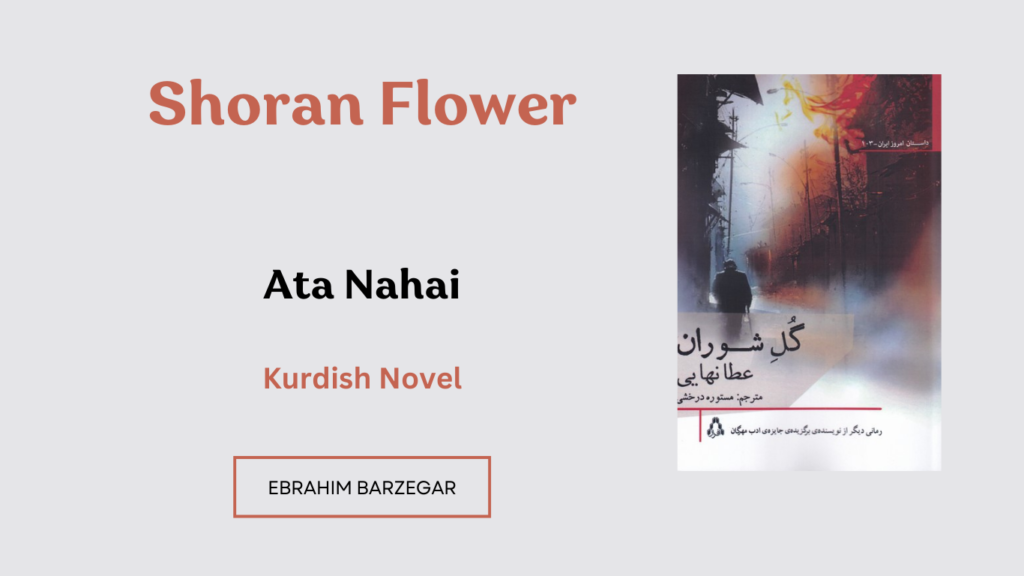
Shoran Flower or Gulli Shoran (1998) is the debut novel of Ata Nahai, the Kurdish novelist who writes in Sorani dialect in Iran.
Shoran Flower, whose title is taken from a famous legendary flower among the Kurds, is set in one of the historic moments of Iran history when Iranians were dealing, on the one hand, with the Anglo-Soviet invasion of Iran on 16 September 1941, particularly Soviet in northern part, displacement, famine and hunger, and on the other hand, the influence of the destructive process of nation-state building based on cultural homogenization and the policy of suppressing various ethnic groups by Reza Shah Pahlavi government (1925 -1941).
Taking advantage of the weakness and incapacity of the central government in the last years of World War II, the Kurds started a public uprising and established the first self-governing state in a large part of Kurdistan known as Republic of Mahabad in 1946, which lasted less than a year. Shoran Flower accounts the problems and sufferings of Vasu (short form of Joseph in Kurdish) and his family members after the failure of the short-lived autonomous Republic of Kurdistan in small border town of Baneh, Kurdistan province.
Las, the eldest son of Vesu Agha returned home after fifteen years and right on the anniversary of his own death. In the Qaybard plain around the city, his shadow went ahead of him and disappeared in the darkness of the night. He passed by the river and through the sycamore and willow trees in such a hurry that he did not feel the croaking of the frogs and the rustling of the dry leaves of the trees, he carefully passed over the stones of the river and left his steps to the narrow path that after the passing of years is still knew them well, unaware that he had to pass by a slaughterhouse that had just been built on that route.
Opening Sentence
Las (short form of Lasem), presumed to be dead, unexpectedly returns home to visit his mother (Daye Guli) , wife (Khanzad) and son (Yadeghar) after fifteen years to realize that his wife married to his brother, Farrokhe, and gave birth to a boy (Hirow), and his old widowed mother shut herself in her dilapidated house with his young retarded brother, Hiwa.
We learn from the omniscient third point of view narrative that his hometown is nothing but a silent and gloomy city which is doomed to be burnt, do does his citizens, in a metaphoric sense. First the town was invaded by Soviet armies and next their wives were raped by their soldiers which led to the Russia phobia, even after the Bolshevik Revolution they still hold deep hate in their heart, despite Las disagreement for he has developed the pro-communist tendency and as a result, joined the Republic of Mahabad group with the help of his friend, Bahram.
After all these years, the once prosperous family of them torn apart and developed a hated toward each other; Daye Guli hated Las for leaving his hometown and his family, Las hated Hirow for his odorous smell, khanzad for her betrayal and Farokhe for marrying his wife.
Hatred and humiliation is deeply rooted in the city, too. The small Jewish community was looked upon contemptuously and called infidels by Muslims. Once Farrokhe fell in love with the Leyla, the beautiful daughter of Shalou Rabbi, Khanzad reminded him that a Muslim cannot marry a Jewish unless Leyla converted to Islam, an unacceptable act which never was fulfilled. An animosity toward them was fuelled later on as some of the Jews warmly welcomed the soviet soldiers as they marched into the city. In the end, all the Jews were forced to leave the city to Palestine, including Farrokhe first lover, Leyla, “ Leyla couldn’t separate herself from her identity, she was Jewish and considered remaining a Jew as a form of companionship and empathy with her community and ancestors”.
After Farrokhe peeped naked Khanzad washing herself through a bathroom’s door, he developed a feeling toward her and she, on the other hand, was desperately seeking a male’s touch, the narrative came to a halt. The narrative was unable to proceed because the scene was antinarratable, since the subject was taboo. The narrator skips the sexual intercourse, but bolds the feeling of the shame and disgust in characters, “She felt nauseous, lost her control and vomited up….she even though about burning herself out of shame”. What the narrator does, in fact, is conveying the sense of guilt to the readers because of an act of adultery which is harshly reprimanded in the represented male-centered Kurdish community, “Its stench [of sin] is so strong that it even protrudes from the cracks in the doors and windows”. In a sense, the family house was burnt down twice, once literally by pro-self-governing Kurdish fighters and once metaphorically by the fire of lust and adultery.
Seeing himself conceived and cuckolded by his wife and seeing his militia dreams evaporated into thin air, Las leaves the city to die after a week stay in his old house and never had a chance to see his beloved son, Yadegar. When Yadegar finally made up his decision to visit his father, it was too late because he has already left the house; he later found his dead coffin carrying on the locals shoulders out of surprise and grief. The world wars and fighting for Kurdish independence made his people displaced and killed, including him and left the alive ones traumatized.