Empty Nets
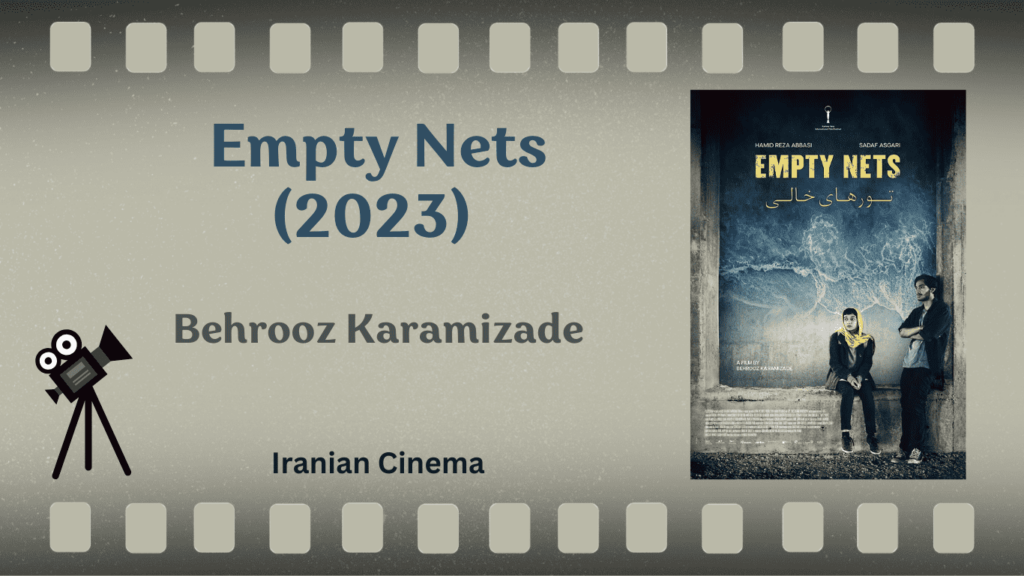
Empty Nets is the debut feature film by Iranian filmmaker Behrooz Karamizade which shows the economic struggle of a young man in present Islamic Republic of Iran. In his film, Karamizade attempts to present the poverty, injustice, and desperation of young generation in an Italian neorealism style.
Amir, a young man in his twenties, has fallen head over heels for Narges, a girl from a wealthy background, and dreams of spending the rest of his life with her, despite his low income and lack of any stable job security. Following a moral disagreement with his boss, Amir is fired from his job as a wedding coordinator. After helping his mother selling home-made bottled pickles , he finds a low-paid working position in a fishery located in Bandar Anzali, a coastal town near the Caspian Sea. To increase his income as soon as possible and to impress Narges and her parents, he decides to take part in an Eel catching fight and betting and later becomes involved with a group of poachers and smugglers in the Fishery. Meanwhile, Narges is presented with a marriage proposal from a wealthy boy from Tehran, which her parents consider appropriate suitor because of his financial stability and social standing. As he delves deeper into the dark and illicit realm of smuggling, his connection with Narges begins to crumble, ultimately leading to their separation. The movie ends up with Amir boarding a boat that sets sail into the vast expanse of the sea, under a brooding, overcast sky.
Economic Struggle in Empty Nets
The central theme of Empty Nets revolves around the economic hardship faced by Amir as a young man in the present day of Iran. The current economic difficulties could be attributed to the United States’ withdrawal from the Joint Comprehensive Plan of Action (JCPOA), commonly known as the Iran nuclear deal and the following series of sanction on Islamic Republic by Donald Trump. The imposed sanctions had significant economic impacts on Iran, leading to a decline in its oil exports, a depreciation of its Rial currency, and a wild rise in inflation. As an example, the monthly rent of a 60-square-meter house in Tehranpars, a quite decent district in the east of Tehran, has risen from nearly $200 in 2014 to $1000 to 2024 per month. This is significantly substantial than the average monthly salary of a worker, which is roughly $700 per month! In addition, there are also expenses related to transportation, food, medical checkups, schooling, and other miscellaneous costs! Welcome to the desert of the economy!
Environmental Crisis in Caspian Sea
The film also brings attention to the problem of plastic waste in the Caspian Sea, a crucial environmental crisis which is hardly shown in Iranian feature films. On his first day of work at the beach, while other workers were busy gathering the large nets, Amir began collecting plastic bottles, nylon, and tin cans left stuck to the nets on the beach. He was reprimanded by his boss, Ghasem, for collecting the trash and was told to throw them into the sea, which Ghasem referred to as a “Dump”.
Ghasem: (With frowning look) What the hell are you doing?
Amir: I am collecting the trashes.
Ghasem: (with anger) Who told you to do so? Throw them away!
Amir: (With a surprising look) Into the sea ?
Ghasem: Yeah. Throw them into the sea. It is a dump. Get back to work.
Another significant environmental issue depicted in the movie is the poaching of Caviar-producing fish. As the story unfolds, Amir realizes that Ghasem and his subordinates are profiting massively by illegal caviar fishing and selling it to luxurious restaurants in Rasht. Working in a fishery is considered as a seasonal job and therefore it is not a promising secure job to rely on for Amir. Despite its high risk, the poaching and the illicit trade of caviar present Amir with a golden opportunity to escape his financial crisis. Amir is hired to collect plastic wastes stuck to the nets because they scare off the fish! In under water shots, Amir is shown with the headlight on encircled with the nets, swimming to cacth plastic wastes.
Allegory of Survival of the Fittest
One of the interesting part of Empty Nets is the eel catching betting. In this competition, two men get into a round small pool and compete against each other to catch the eel first. In wild fast-cut scene, the fish workers are betting on competitors, organized by the head of the fishery, Ghasem. At his first attendance, Amir, a skilled swimmer, ambitiously gets into the pool ring, and wins the competition. The camera shows the underwater fights between the competitors while they are after the agile eel. So, the eel-catching competition is an allegory of the survival of the fittest concept. In water, he could easily catch the prize, but on land, no matter how hard he tries, he cannot compete with potential suitor for Narges.
Allegorical Waterscape and Seascape in Empty Nets
The seascape in the Empty Nets could be considered as an allegorical space where the protagonist struggle with life is reflected upon. Fired from his job in city, he lands a job in the beach seine fishery, a traditional fishing method that involves pulling a seine net from the shore to catch fish, which requires significant strength and manpower. As a wedding coordinator in the city, Rasht, he wore a clean bright suit, responsible mostly for gathering wedding cakes and arranging the dining table. However, in his new role on the beach, he wears dark attire that is resistant to water, including rubber boots and a woollen hat. His occupation entails the tasks of setting up, drawing in, and manually tugging on ropes connected to the net in chilly and windy environment. Its overwhelming greatness cannot be overcome by Amir, despite his effort. The seascape is the mirror reflection of the land working exploitation. As an skilled swimmer, he dives into the sea and collects plastic wastes stuck to the nets, so the fish fall into the trap. But, it is not him, but Ghasem who gets the most of the profits.
Moreover, the seascape is shown as an impassible space for intellectuals in Iran. Omid, hiding under the alias of a worker, is a blogger and writer being pursued by the Islamic Republic for his political views. He made an agreement with Rahim, human smuggler, a close associate of Ghasem, to smuggle him to Azerbaijan by boat in return for a substantial sum of money. And now he is running out of patience. Omid is the representative of intellectual individual who are condemned for freely speaking their ideas and criticism of the current situation. Desperate to leave the country and disappointed by Rahim’s deal, Omid asks Amir for illegal transportation across the Caspian Sea. He gives an offer Amir cannot refuse. They set off after sunset into the sea, but the wind begins to gust, causing the sea to become turbulent. While on boat, Omid tries to catch and protect the money and personal document wrapped in plastic from the splashing water, despite Amir’s warning against it. While attempting to catch the bag, he gets tossed into the sea and drowns as the boat hits a wave. For Amir as a worker and Omid as an intellectual, the seascape is an allegorical space of economic and political struggles, respectively.
I watched Empty Nets at Akademia Sztuk Pięknych w Krakowie at Offcamera film festival 2024 in Krakow, Poland.