Gojastak Abalish
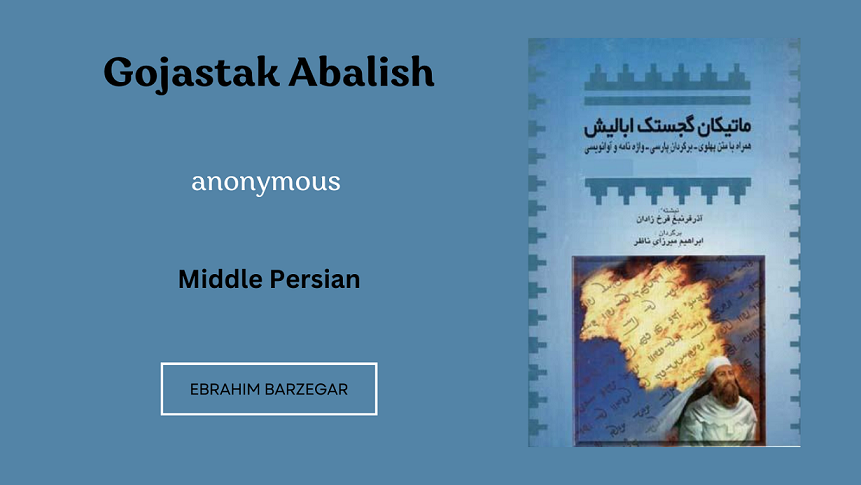
Gojastak Abalish or Gizistag Abalis is an apologetic treatise between Adurfarnbag, a Zoroastrian, and a heretical Zandiq, Abalish. Abalis puts seven questions to Adurfarnbag about Zoroastrian doctrine that he answers truthfully and reasonably. Each answer puts a gentle smile on the face of the Islamic ruler, Al-Ma’mun, who was an ardent supporter of science and knowledge.
The eponymous antagonist of the text is Abolish or Abalis, a dweller in Istakhr, Fars Province. The name, according to scholars, is not Persian. However, as the title says, he is accursed or Gojastak. Gojastak has previously used for Ahriman or evil and later for Alexander, The Great because he burnt holy books of Zoroastrianism when attacking the Persians in 330 B.C. One day Abolish, formerly a follower of Mazdeism, stepped into a fire temple in Istkahr to practice Baj or Waj, whispering prayer before and after a meal. But, he was not treated respectably and was forced to leave the holy place. Feeling humiliated, he traveled to Baghdad to ask the Caliph for judgment. On the other hand, Adurfarnbag is the protagonist, a defender of Zoroastrianism. Adurfarnbag, the son of Farroxzadan or Farrokzadan, is the first author of the Zoroastrian compilation, the Dēnkard, Encyclopedia of Mazdaism. He is praised as the leader of Mazdaism in the 9th century because of his thorough knowledge of theology and religion in books such as Shkand-gumanig Vizar, Dadestan-i Denig, Zand-i Vohuman Yasht and Shayest Na-Shayest.
Like other Pahlavi texts, Gizistag Abalis’s topic is related to religion. Abalish targets some of the pillars of Zoroastrian beliefs such as dualism and its implications (Fire and Water, Punishment and reward); the reason to worship fire which is weak in essence and needs care and ritual and custom (use of cattle urine, gomez, for ritual purification and use of the sacred girdle (kustig). The debate between Azarfarnabag and Abolish took place in the court of Al-Ma’mun (786 –833). Probably it goes back to the late period of his reign, after the death of his astute Persian Vizir, Al-Fadl ibn Sahl in Sarakhs, 818, because he was busy quelling civil unrest in an Islamic land. According to the text, the debate takes place before Al-Ma’mun and religious leaders; Islamic, Christian, and Jewish.
Islamic Version of Gojastak Abalish
Talking about history is a tricky thing. While scholars agree upon the event of Gojastak Abalish, Abol Ma’li, a theologian in the 11th century, narrates a similar debate story where Islamic Jurists convinced the heresy of the Zoroastrian. As a result, Al-Ma’mun issued the order to kill him. Al-Masudi, the great Arab Historian, in Meadows of Gold and Mines of Gems points to Al-Ma’mun’s enthusiasm for religious debate. However, since the Islamic discourse was dominant back then, it is not surprising and almost probable that the account underwent radical alteration. For instance, Ibn Babawayh, the Shitte scholar in the 10th century, narrates a similar event in Islamized version where Imam Reza debates with high-ranking leaders of Exilarch, Catholicos, Sabians, followers of Zabuur, and arch-mobed of Zoroastrianism. We are not sure, but this version could be the Islamized account of Gojastak Abalish.
Gojastak Abalish Translations Gojastak Abalish was originally written in Pahlavi, middle Persian language. Homi F. Chacha, an Indian Parsee translated the book into English with the title of “Gajastak Abâlish” in 1936. Prods Oktor Skjaervo also translated the book into English.