Arda Viraf Book
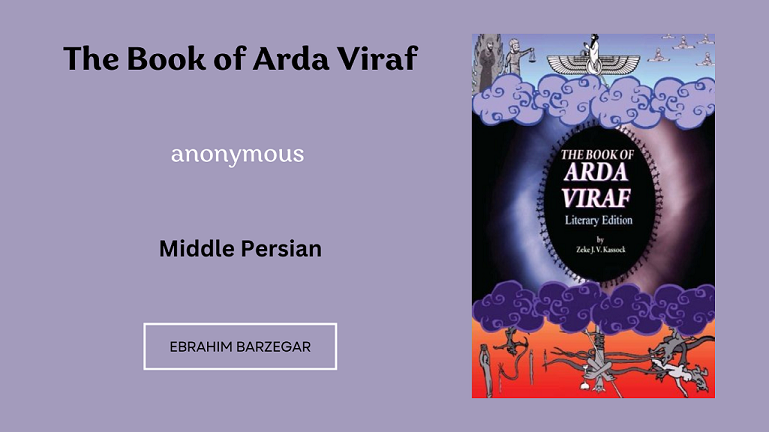
Arda Viraf book or Arda Viraf Nameh is a dream journey of a Zoroastrian religious man into Heaven and Hell.
The antagonist is called Arda Viraf, whose name is open to debate. Some scholars believe that Arda has an otherworldly connotation, but several others suggest it means trustful or righteous. The same thing goes for the second part, too. On the one hand, some argue that the name of this religious man is Arda Wiraz as once mentioned in Avesta. On the other hand, some claim his name is Viraz according to Pazand and Sanskrit language. To make it more complex, the anonymous writer introduces him as Veh Shabur, top-ranking Mobeds (Zoroastrian religious men are called Mobed), with seven sisters/wives. That is all said in the text. There is no historical record of such a man in ancient Persian history. It might partly be because of many rewriting and altering of the text after the fall of the Sassanid Empire.
Arda Viraf book’s Author & Date
The author and date of writing of Arda Viraf’s book are unknown. However, scholars believe that it dates back to Sassanid Empire (224 to 651) due to the appearance of some historical names. The author begins his book by introducing Zoroaster and three hundred years of purity and faith in Zoroastrianism. Then the evil-doer Alexander, the Roman, invaded Persia (330 BC) and burnt the holy books of Avesta and Zand, written on cow-skins with gold ink safe kept in Stakhar Papakan (Cube of Zoroaster).
Alexander’s death brought confusion to Iranshahr and religions of many kinds, and different fashions of belief, skepticism, and various codes of law were promulgated in the world. According to late books written on Persian History, it is said that this Confusion period refers to Parthian Empire (247 BC – 224 AD) which was famous for religious tolerance. It was Adurbad Maraspandan, the minister of Shapur II (309-379 CE), who brought the glory of Zoroastrianism back to Iran again. Another historical name mentioned in Arda Viraf’s book is Veh Shapur, the famous Mobed in the time of Khosrow I (531-579 CE). These names enhance the chance of estimating the date of writing to the Sassanid Era.
Spiritual Journey
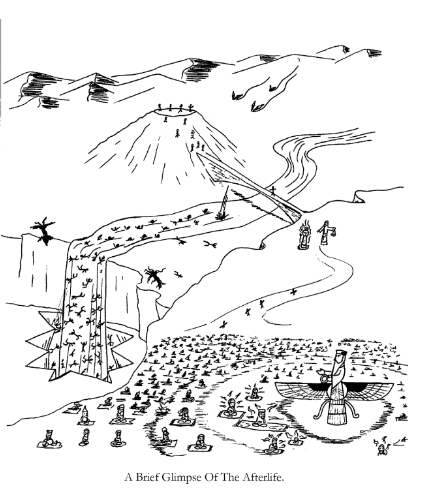
According to this Middle Persian text, Arda Viraf was selected out of seven righteous men. He embarks on this journey wholeheartedly despite his sisters/wives’ disapproval. After drinking a mixture of wine, mang (Indian Cannabis), and Haoma (Divine plant in Zoroastrianism), his soul went from the body to Chinvat Bridge and returned after seven days and nights. Meanwhile, his soul was roaming around, and his seven sisters reciting Avesta were sitting on Persian Carpet next to an ever-burning Fire. After coming back from the afterlife, he asked for food and wine. Then he began telling his vision of heaven and hell. Arda Viraf’s vision of heaven and hell is similar to otherworldly monotheistic religious visions. In aromatic heaven, he can, “taste immortality and pleasure eternally. The heaven is home to devotees of Zoroaster. Heaven dwellers are categorized into three sections: Star, Moon, and Sun. The author names “Gayomard (Keyumars), Zartosht, Kai-Vishtasp, Frashoshtar, Jamasp, and other well-doers and leaders of the religion” as well. To enter hell, the wanderer again walks on Chinvat Bridge, where a dreadful river runs beneath it. In this part, the author lists the sins and punishments of evil-doers grotesquely. Here are some most frequent sins in hell: disrespect to four elements known as Akhshig, adultery, cruelty to animals, False judgment, sorcery, backbiting, and telling lies. It is important to note the anti-feminism perspective of the author in the book could be traced in other Abrahamic religions as well.
Persian Divine Comedy
Divine Comedy, written by Dante in 1320, revolves around the vision of the afterlife in Christianity. Dante goes on a journey to Inferno, Purgatory, and Paradise with Virgil and Beatrice . Dante’s belief in Holy Trinity made him divide the world’s map into three parts; on the other hand, duality in Zoroastrianism made Arda Viraf see it in two parts: heaven and hell. Both books represent the established religion of their given time by the religious authorities; Mobed Mobadan in Zoroastrianism and Pope in Christianity. One can say that Arda Viraf is a forerunner of the spiritual journey to the afterworld in world literature which Divine Comedy is the par excellence.
Arda Viraf and Mi’raj
Arda Viraf Journey and Mi’raj’s journey by Islamic Prophet Muhammad share certain similarities. First, both travelers were introduced as chosen persons and prophets in holy texts. Muhammad, like Arda Viraf, goes on a night journey, both physical and spiritual, on the back of a white-winged beastlike horse called Buraq to heaven. His journey to heaven is called Mi’raj, which means “ascending”. Muhammad is accompanied by Archangel Gabriel, while Arda Viraf has two companies; Soraosha or Sorosh the pious, and Adar the angel. Muhammad meets Adam, Abraham, Noah, Moses, and Jesus on his journey; however, the Zoroastrian messenger never meets Zoroaster. In both divine voyages, the visitors narrate their visions of heaven and hell to confirm the common belief in the afterlife. Whereas the Zoroastrian version was marginalized throughout history, the Islamic account of the night journey, nearly 400 years after Arda Viraf, was praised lavishly in literature and painting, particularly Persian Miniature. The shining example of Mi’raj illustration is in Khamseh of Nizami in the 16th century.
Adaptation: Arda Viraf Report
Arda Viraf book is adapted into a play named Arda Viraf Report by Bahram Beyzaei, where Arda Viraf meets the pantheon of characters from Persian history and mythology.