A Red Gable Roof House
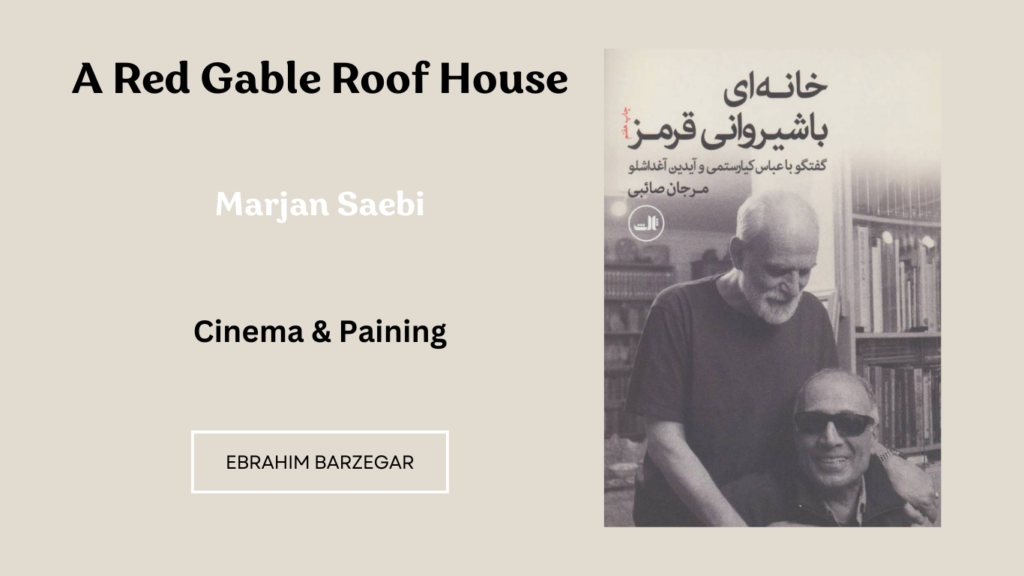
A Red Gable Roof House is a joint interview book between Aydin Aghdashloo and Abbas Kiarostami by Marjan Saebi in 2016.
Aydin Aghdashloo and Abbas Kiarostami are renowned Iranian artists who gained national and international fame through their artistic works. The former is considered one of the greatest contemporary painters, and the latter is undoubtedly the best Iranian filmmaker of all time. These two artists, once classmates, met each other with the help of Marjan Saebi to walk down memory lane after 60 years. This one-hundred-and-one-page book has thirteen sections, focusing on Aydin Aghdashloo and Abbas Kiarostami’s childhood and teens. Since A Red Gable Roof House is not available in English, I am sharing (my translation) some parts of their dialogue with you.
Before the Interview
Rumor has it that Kiarostami refused to converse with Aydin Aghdashloo because he believed that Aydin would start to talk about his art and things which is boring for him. However, this time Aydin warned Kiarostami, “Stop postponing it for tomorrow! How sure you are to be alive tomorrow.” Aydin asked Kiarostami to seize the day and have a conversation before it was too late. He welcomed his schoolmate in the basement room (In the Old Persian house architecture, the basement was a quiet place for privacy) of his house on Sohervadi Street for a cup of tea and talk.
Intimate Companions
It all started at Jam School in Qolhak, Tehran. Aghdashloo was energetic and naughty, but Abbas was quiet and isolated. Despite their close friendship then, they beat each other hard. Their two favorite classes were composition and painting because they could find peace in the fictional world. Later on, Aydin began to work at Reza Abbasi Museum for a short time, while Kiarostami started to work at The Institute for the Intellectual Development of Children and Young Adults in Tehran. At first, they talked about the death of their childhood classmate, Bahman Farzānah, one of the best translators in Iran who came into the spotlight with his brilliant translation of One Hundred Years of Solitude from Spanish into Persian.
Aydin: Death is a complex and sensitive issue. One should not cry or beg or ask for help. One should die with grace.
Kiarostami: I don’t think it will happen to us.
Aydin: But, is the death pitiful? Those who want to use a person has this kind of attitude. One should see what that person feels toward death. She/he might be bored! Or even without motivation!
Abbas: Have you reached this point?
Aydin: Never!
Abbas: That’s right. I think death will happen when one has no incomplete tasks. We have incomplete tasks for good. If we are taken from this world before completion, I think it is unfair. We shouldn’t be taken to the other world while we are busy with our tasks.
Aydin: My only concern is that I die in this basement because I think my coffin will be carried in a vertical position due to the narrow staircase (Laugh)… Ahmadreza Ahmadi has been asked once “Who would you like to carry your coffin?” and he answered, “Aydin and Masoud Kimiai”. We are not strong to carry that. (Laugh)
Abbas; You know. You can not have a vertical coffin, but you can be buried vertically.
Aydin: There is a famous tale about Harun al-Rashid’s death. Rumer has it that the earth did not accept him (Due to his high-ranking position in the Islamic world). So, they buried him in a vertical position. We are not Harun al-Rashid.
Aydin: How one should be lucky to tell his friend we meet each other on Wednesday afternoon! Which Wednesday? You might die on Tuesday! One should be hopeful to see Wednesday afternoon!
Childhood Memories
Aydin: Abbas is quiet but astute. I have written somewhere that Abbas was an observer at school; he never got involved. How could we know that he recorded whatever he was watching in his mind? You can mark my words in “The Traveler.” The boy in the film who is wearing a handkerchief around his head. He has a toothache. That’s me.
Abbas: I think whatever I make (Films) goes to my childhood. I have had nothing to make since thirty years ago. My memory is full. But I can’t take out even 10% of it… Aydin used to wear a kind of handkerchief around his head in a triangle form – so-called Rabbit-like – and fooled teachers of having a toothache. I got this idea from Aydin.
Abbas: We had a big fight at school without even swearing at each other. We fought in silence.
Abbas resumes his talk by telling his experience in “Bahram School” in Ekhtiarieh, the first school in the entire area. He finishes primary school in there but continues his high school at “Jam School” in Qolhak.
Abbas: I lost myself in school. One of the reasons for my seclusion was unintentional and out of fear. (Laugh) I stood next to the wall in the yard. I saw that my new classmates have nothing in common with my previous ones. I noticed Aydin on the second or third days. I met a new semi-well-fared class which was alien to me…. One day Aydin was drawing something. I tried to see his drawing over his shoulder, but he hid it under the seat with a frown.
Marjan: Why?
Aydin; Why did he look at my drawing? I didn’t want him to learn!
Marjan: Did you draw or paint again?
Abbas: Yes. Aydin got down with flu and couldn’t move.
Aydin: I didn’t go to school for a year. One day I woke up and saw I could not move my body.
Abbas: I failed that year because of my loyalty to him! When Aydin returned, he was different. Fazlollah Payami was an educated boy, so he brought books for Aydin to read. Aydin stayed at home for a year and just read books.
Aydin: I read books days and nights for a year.
Abbas: I remembered the books made me approach him. I remembered he had The Ministry of Fear (By Graham Greene) and Eugene O’Neill’s books.
Marjan: Did you miss school?
Aydin: No. I enjoyed myself because I read so many books. I even read Divine Comedy. I didn’t do any other things because I couldn’t move my hands and legs. I borrowed books. I was dirt cheap.
Marjan: Since when did you get close to each other?
Aydin: It took years to discover Abbas again. To me, Kiarostami was one of the cleverest guys that I knew. He could stand far and look. I discover this standing far later on. I still say that one of the definitions of intellectualism is that one could stand far and see things and himself from the outside. Abbas has always stood far. When he entered the university, we were all amazed by his paintings. They were personal and especial.
Marjan: Did you work at that time?
Aydin: Before entering the university, I made card postal for Armenian painters who sold them to tourists. I worked with watercolor then.
Abbas: Did you know Aydin wrote poetry, too?
Marjan: I didn’t know.
Aydin: My poetry notebook is with him.
Mediocre Men with Little Happiness
Aydin: I have written a short review of The Report (1977), and I still believe that The Report is the best work of Abbas Kiarostami. It refers to something that was the issue of the time. I mean, it shows mediocre men who were happy with little happiness. They were busy with little arguments. And whatever happened, it never meant the end of things. It was like snapping someone. It hurts, but it never stops. For example, a woman who commits suicide never dies. Then we used to live in an atmosphere where the happenings were either catastrophes or blissful happiness
Marjan: Did other filmmakers have the same attitude then?
Aydin: Yes, and it never happened again. For instance, Tranquility in the Presence of Others (1973) was bitter, sentimental, and oriented.
Marjan: Did you have a good relationship with each other then?
Aydin: He worked in Kanon and we met each other there.
Abbas: We were in touch, so so. The thing is Aydin influenced my life at the right time. None of my friends ever influenced me. Because if they did, it would show itself today. I borrowed his books and followed his paintings. The most important phase of life is the teens when you are malleable.
To a God Unknown
Marjan: Which books influenced you?
Abbas: It does not matter, but I still like To a God Unknown by John Steinbeck. Aydin gave this book to me, and now that I look back to The Reporter I think those books then really influenced me…it stuck in my memory. It had a nature that exists in my films and paintings. The story revolves around a man who goes to a vast arid land and attempts to make it habitable single-handedly. But, draught comes up. The man lives with his wife and a dog. When there is no rain anymore, he kills himself with a gun like Steinbeck. In the end, the sound of the gunfire mixes with the sound of thunderbolts, and the rain washes his blood away. This scene was extraordinary to me.
Marjan: Whose paintings influenced you?
Abbas: I am working on impressionist paintings. I mean that you see thirty seconds of Gauguin or Van Gogh, and it all comes to life. It is marvelous. Thirty seconds of look, and it starts to animate without any changes in the details. There is a painting that I would like to ask Aydin about it. It looks like a couple lying on the grass.
Aydin: It is rework of Millet. Millet is the master of painting resting after finishing his work.
Abbas: I am concerned about the work. I add the gleaners, too. I would like to do something we see the gleaners stand upright.
Aydin: It is so good you come back to painting.
Abbas: Is it possible to make films without painting and photography? I always tell my students in film workshops, if you don’t paint or take photographs, how do you want to enter the cinema? With literature? Entering the cinema with the story is a catastrophe. It is impossible to make films without any painting or photography’s experience.
Identification with Van Gogh
Marjan: You have told us that you made films with personal expenses. All in all, did you have a good time?
Abbas: Saying that It was a good time is not correct, because it might have a bad reflection. It means that one waits for the best time to come, so he could build herself. But, from my perspective, art has nothing to do with good or bad times; because it is a personal act on which a set of responsibilities befall his shoulders. The artist cannot blame the state for her issue.
One of my infatuations to enter Tehran University of Art was the Van Gogh. A book called Lust for Life was published then. When I read the book, I found that my situation is a bit better than Van Gogh’s. I learned from Van Gogh’s miserable situation that I could be a painter, too. His economic and social life was like me.